Surface appearance
A hypothetical application for a team trying to distinguish a relevant surface mark from acceptable appearance variation.
Explore the research situation ↗Research & Development / Denver, Colorado
ONE STOP PLUS LLC helps product and operations teams investigate camera-based inspection concepts: define the feature, examine capture conditions, and evaluate what the results can establish.
Explore our research focus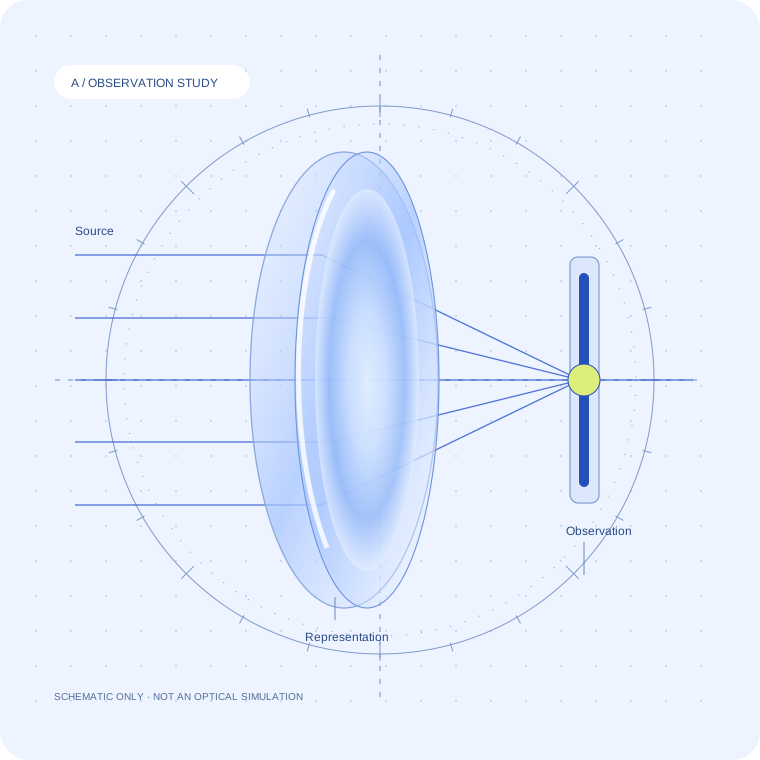
Observation study / An interactive illustration
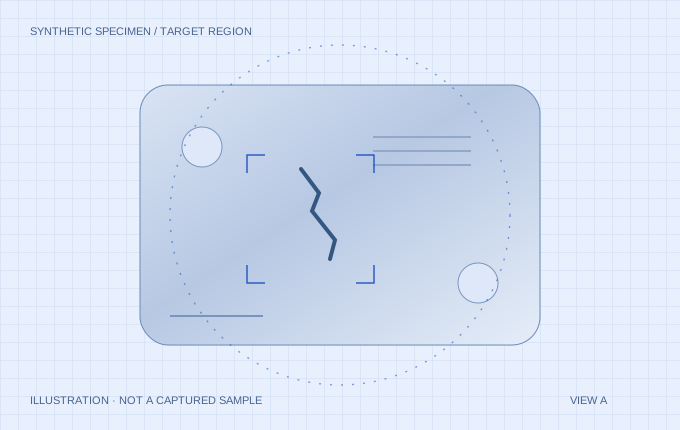
Use the three views to explore why recognizing an object is different from seeing the feature an inspection needs. These are deliberately simplified, synthetic drawings.
An image is evidence under conditions.
The mark is distinct from its immediate surroundings in this invented illustration. A real study would still need representative examples and an agreed inspection rule.
Define the inspection feature ↗Illustration only: no camera access, image upload, optical simulation, or measurement is performed. The views do not report company research results.
Research focus / Four connected questions
A camera specification is only part of the problem. Research needs a defined observation, a usable view, an evaluation method, and a proportionate interpretation of the findings.
Specify the object, the feature, and the action the observation needs to support.
Inspection definition ↗Examine visibility, framing, lighting, and the conditions that make a view inadequate.
Capture studies ↗Define examples, reference judgments, and the errors that need to be reported separately.
Evaluation design ↗Connect observations to their conditions and identify what remains before practical use.
Evidence interpretation ↗Illustrative applications
Hypothetical situations show how the research focus connects to ordinary development needs. They are not customer projects or performance claims.
A hypothetical application for a team trying to distinguish a relevant surface mark from acceptable appearance variation.
Explore the research situation ↗A hypothetical application for a team considering whether an image can support a check of component presence or placement.
Explore the research situation ↗Measurement notes
Five practical guides explain the image, the examples, and the outcome categories behind an inspection evaluation.
Browse all measurement notes ↗Contrast is about the distinction that matters in the image, not simply making the whole scene brighter.
The detail needed for an inspection depends on the feature, its representation in the image, and the conditions under which that image is captured.
Inspection results become useful when the evaluation distinguishes the kinds of error and the work they create.
A useful image collection represents the variations and ambiguous cases the intended task must handle, not only the easiest objects to photograph.
An early inspection study can establish useful observations while leaving installation, operation, and maintenance questions unresolved.
Start with the object, the distinction that matters, and the action that would follow an observation. A written description is enough for the first conversation.